What to do if you break down
It can be hard and sometimes dangerous to stop if you've broken down.
Warn other road users by using your hazard warning lights, and if possible, get your vehicle off the road.
The hard shoulder is for emergency use only. You should only stop on a motorway if it is a genuine emergency and you have no choice. If you can, always try to drive to a safer place off the motorway rather than stopping on the hard shoulder.
Here are our tips on how to stop safely and summon assistance.
On a motorway with a hard shoulder
You cannot stop on the hard shoulder for a non-emergency, such as to go to the toilet, to take a phone call or to check a map. If an emergency forces you to stop:
- pull onto the hard shoulder and stop as far to the left as possible with the wheels turned to the left (i.e. away from the motorway)
- leave your sidelights on and turn on your hazard warning lights
- get out of the vehicle by the passenger-side door and make sure that all your passengers do the same
- wear a reflective jacket if you have one
- don't use a warning triangle on a hard shoulder
- don't attempt any repairs yourself, even simple ones
- move up the bank and away from the carriageway — always stay behind the crash barrier if there is one
 Call for help
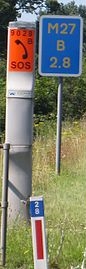
Once you're in a safe place, use your mobile to phone for breakdown assistance. It helps to store your breakdown service number in your phone in advance, or keep a card or other note of the number in the glovebox. Make sure you can describe your location — as well as the older marker posts, there are new larger driver location signs to help in locating you.
If you don't have a mobile phone, walk to the nearest emergency telephone. On the back of the marker posts, you'll find an arrow which will show you which direction the nearest one is. Always use the telephones on your side of the carriageway — never attempt to cross the road. The emergency phones are free and connect you directly to the police or Highways Agency control room. Give full details to the police and let them know if you're a vulnerable motorist, such as a woman travelling alone.
If you feel at risk from another person, return to your vehicle by a passenger-side door and lock yourself in. Leave the vehicle again as soon as you feel the danger has passed.
Rejoining the carriageway
Use the hard shoulder to build up speed before rejoining the carriageway using a safe gap in the traffic. Be aware that other vehicles may be stationary on the hard shoulder ahead of you.
If you can't get across to the hard shoulder
Stopping in the carriageway is extremely dangerous. Switch on your hazard warning lights, but don't attempt to place any warning device on the carriageway. Leave the vehicle only when you can safely get clear of the carriageway.
What if I'm on a smart motorway without a hard shoulder?
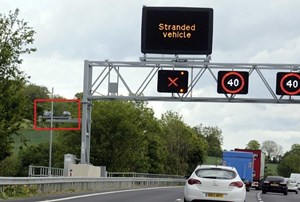 If the hard shoulder has been converted into a permanent traffic lane and you need to stop in an emergency:
- use an emergency refuge area, motorway service area or leave at the next junction
- if this is not possible, try and get the vehicle off the carriageway, if it is safe to do so
If you have no choice but to stop in a live lane:
- use hazard warning lights to help other drivers see you
- if you are in the left-hand lane and it is safe to do so, exit the vehicle via the passenger-side door and wait behind the barrier if possible
- if you don't feel it's safe to leave the vehicle, or there is no other place of relative safety, stay in the vehicle. Keep your seatbelt on and dial 999.
As soon as the Highways Agency is alerted, the control centre will use the electronic signs to close the affected lanes to protect you while you wait for help to arrive.
Emergency Refuge Areas
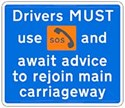 Instead of a continuous hard shoulder, you will find Emergency Refuge Areas at regular intervals on a Smart Motorway.
National Highways operators in the control centre won't be alerted automatically when a vehicle enters or leaves a refuge area, but if you have to stop, you will see signs instructing you to use the emergency telephone to contact the control centre. Operators will then be able to monitor your vehicle using CCTV.
Because refuge areas are relatively short laybys, it isn't possible to build up speed before rejoining the carriageway. Before leaving the refuge area, use the emergency phone to contact the control centre again. They can send a traffic officer to assist you, and/or set the electronic signs to provide a gap in traffic (if you're driving and a red cross appears above lane one to close it, it could be to allow a slow-moving vehicle to rejoin the motorway from a refuge area.
On other roads
If possible, try to pull off the road, otherwise try to pull as far over to the left as you can. Use your hazard warning lights to warn other road users, especially if you're obstructing the road.
- Wear a reflective jacket if you have one
- If you are at all worried that your vehicle may be struck by other traffic, exit the vehicle and get well away from the traffic. Ask yourself whether it is safe for you to try to fix the car, or if you should wait for professional help.
- If you have one and it is safe, put a warning triangle or other permitted warning device on the road at least 50 yards (45 metres) behind your broken-down vehicle on the same side of the road (remember to retrieve it once your breakdown is over.
- Keep your sidelights on if it is dark or if visibility is poor.
- Don't stand between your vehicle and oncoming traffic.
- At night or in poor visibility, do not stand where you will prevent other road users from seeing your lights.
- Use your mobile phone or a payphone to contact your breakdown service.